The full English after a night investigation, and why I need it
Nadia explains the unglamorous bit nobody films: the hours after the cameras stop, the sleep that never properly comes, and the breakfast that gets the notes written up.
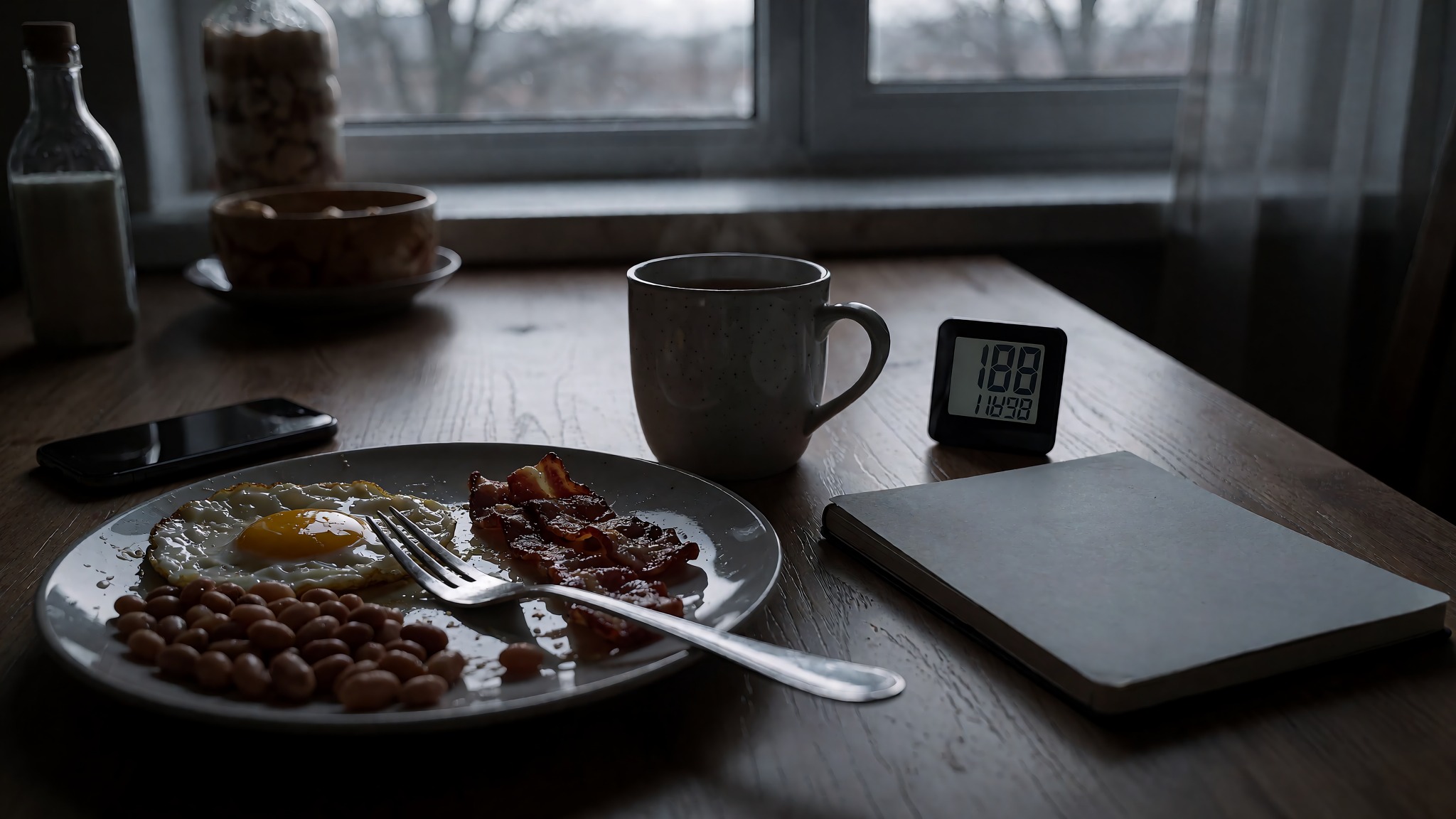
Right, so here’s a question nobody asks me. Not “did you see anything”, not “were you scared”. It’s “what do you do after?” And the honest answer is: not much, badly, for about six hours, until a fried egg sorts me out.
People picture the end of an overnight investigation as a clean cut. Cameras off, torches off, everybody goes home and sleeps like the dead, ironically. That is not what happens. What happens is you’ve spent eight or nine hours in the cold, running on adrenaline and instant coffee, straining to hear a floorboard over your own heartbeat, and then somebody says “right, that’s it” and your body has absolutely no idea what to do with itself.
Why you can’t just go home and sleep
I used to think the exhaustion would knock me straight out. It doesn’t. You come off an investigation wired, not tired, even though you’re both at once. Your ears are still doing the job they were doing at two in the morning: picking out every creak, every car outside, every pipe settling. I’ll lie there at half past five with my eyes shut, and my brain is still running the tape back. Did that bang come from upstairs or from the radiator? Did the dog bark before or after?
Some of that is the job itself, I think, and some of it is the kit. I run a little humidity logger through the night, a Bluetooth room thermometer and hygrometer that sits wherever the “cold spot” is meant to be, and it quietly logs a temperature and humidity reading every few minutes for me to go through later. Useful, because a lot of what people report as unexplained turns out to be a draught nobody’s accounted for, or a damp patch that’s made a wall feel colder than it is. Less useful at five in the morning, when I’m still awake with my ears doing their work, and the logger’s just sat there with nothing for me to check until I’ve got the app open at breakfast.
The comedown is part of the job, not a bonus feature
There’s a version of this where I’d tell you the comedown is glamorous, all moody reflection and candid diary-style confessions. It isn’t. It’s me, unwashed, slightly cold because the car heater’s rubbish, driving home at the hour normal people are setting alarms, trying to work out if I’m hungry or just running on fumes. Usually both.
What I’ve learned, the slow way, is that you can’t go straight from “listening for a ghost in the dark” to “sensible and asleep”. There has to be a landing. For me that landing has always been breakfast, and it has to be a proper one. Not toast. Egg, bacon, beans, the lot. My dad, who will not hear a word about any of this, at least agrees with me there: “you can’t think straight on an empty stomach”, which from him passes for support.
Why the notes get written over bacon, not before bed
Here’s the bit that actually matters, though, underneath the jokes about my dad and my sleep schedule. The best notes I write are the ones I write at the breakfast table, not the ones I try to scribble in the car at 3am with a torch in my teeth.
In the moment, everything feels significant. A bang, a cold draught, a shadow that moved because someone walked past a window outside. If I wrote my report straight off the back of that, half of it would be adrenaline talking. Give it an hour, a shower, and a plate of something hot, and the same evidence looks completely different. That bang usually turns into “the central heating coming on”. That shadow usually turns into “my colleague, also present, also human”. That’s not me being dismissive, it’s the whole method: you let the excitement settle before you decide what you actually saw.
So the full English isn’t really about the food, not entirely. It’s the thing that marks the end of “collecting” and the start of “checking”. I’ll sit there with my notebook, going through what was logged, what the humidity reading actually showed against what somebody swore they felt, cross off anything that’s got an ordinary explanation sitting right next to it, and keep what’s left. Some mornings that leaves nothing. Some mornings it leaves one genuinely odd line that I can’t explain yet, and that’s the one that gets written up properly later, once I’ve slept and I’m not just tired and hopeful.
So no, there’s nothing mystical about the morning after. It’s cold eggs going warm again because I’ve stopped to reread a page, a dad who still won’t ask what happened, and a page of notes that’s more honest at nine in the morning than it ever was at three. More when I have it.